2026-04-14 · Blackboard
What Is a Non-Custodial Wallet
Open your bank app and you'll see a number. A thousand dollars, ten thousand, whatever the figure. That number isn't your money. Strictly speaking, it's a single row the bank has written into its database, with your name next to it.
Your brokerage account works the same way. Holdings, market value, cash balance — all rows inside a brokerage server. Every piece of digital finance built by humans works like this. The screen you look at is a copy of a ledger that some company maintains on your behalf.
A non-custodial wallet inverts this structure. Your assets live directly on a blockchain, not on a company's ledger. What that actually means, and why it matters — explained for someone who has never used a wallet before.
Digital Finance Runs on Someone's Ledger

Banks, brokerages, insurance companies, exchanges — every digital financial company humans have built operates the same way. Inside a large data center sits a database that constantly records who owns how much. Transfers, payments, trades — they all reduce to editing two rows simultaneously: decrement A's balance, increment B's.
Finance has a word for this: custody. A company holds your assets on your behalf and promises to return them when asked. What you actually own is not the asset itself, but a claim against that company.
The convenience of this model is real. Forgotten passwords reset. Misdirected transfers reverse with a phone call. The system acts as your safety net. All on one assumption — that the company keeps operating normally.
When the Ledger Breaks
What happens when a company doesn't operate normally? The short history of digital finance has answered this question more than enough times.
- FTX (2022) — the world's second-largest exchange filed for bankruptcy after misappropriating roughly $8 billion in customer funds for affiliate trading. The balances on user screens were not backed by real assets.
- Mt. Gox (2014) — the exchange that handled 70% of global Bitcoin volume lost roughly $450 million to hacks and internal disappearance.
- QuadrigaCX (2019) — Canada's largest exchange lost access to its cold wallet keys when its CEO died. Approximately $190 million remains permanently frozen.
- More recently — Bybit's $1.4B hack in early 2025, Coincheck's $530M loss in 2018, and dozens of smaller failures across every jurisdiction.
The pattern is simple. Assets you don't directly control can vanish based on the operating condition of whoever holds them. Hacks, embezzlement, bankruptcy, lost keys, government freeze orders — any one of these turns your balance into a meaningless line in a defunct database.
Add the daily friction. Wires don't move outside business hours. International transfers take days. Large transactions require additional verification. Suspicious activity gets accounts locked. The other side of convenience.
What a Non-Custodial Wallet Changes

A non-custodial wallet places your assets directly on a blockchain — a public ledger — instead of on a company's database. Your assets are no longer a row in some corporation's storage. They are an entry in a public ledger validated simultaneously by thousands of independent nodes around the world.
Authority to move those assets lives in a cryptographic number called a private key. Whoever holds the key can move the assets. Whoever doesn't — exchange employees, governments, attackers — cannot move them, period.
This produces three concrete consequences:
- No one can freeze you. No customer service team to lock your account. No compliance department to halt your withdrawal. Your key is the only authority that matters.
- The wallet outlives the company. If the app you're using shuts down, the funds remain on-chain. You access them through any compatible wallet or interface.
- It runs 24/7/365. No business hours. No holidays. No borders. Blockchains don't stop.
These guarantees aren't promises from a company. They emerge from the protocol itself. Math, not policy, enforces them.
The Three Types of Non-Custodial Wallet
Non-custodial isn't a single thing. The category breaks into three forms based on how the key is stored.
| Type | Key Storage | Recovery | Best For |
|---|---|---|---|
| Hardware (Ledger, Trezor) | Keys on offline-only device | 12/24-word seed phrase | Long-term storage, large balances |
| Software (MetaMask, Phantom) | Keys on your PC/phone | 12/24-word seed phrase | Daily trading, DeFi |
| Embedded (Privy, Web3Auth, MPC-based) | Key split into shards across parties | Social login (Google/Apple) | New users, mobile-first |
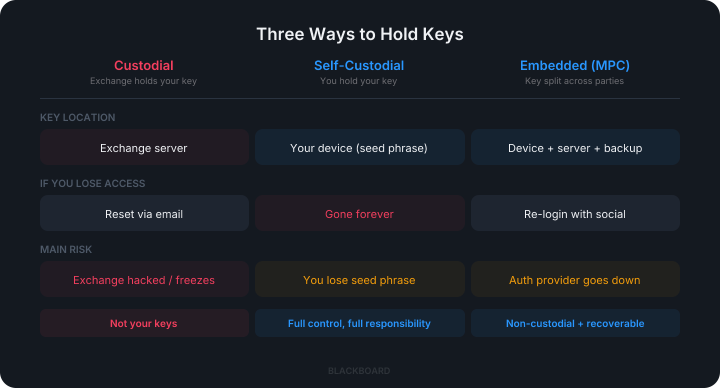
Hardware and software wallets are traditional self-custody. The 12 or 24 English words of the seed phrase are the key itself. You write them down, you keep them safe. Lose them and there is no recovery — roughly 20% of all Bitcoin in existence, more than $100 billion, sits permanently locked in wallets whose seed phrases are gone.
Embedded wallets are the evolution of this model. Multi-party computation (MPC) splits the key into fragments — shards — distributed across separate parties. A typical setup uses three: one on the user's device, one with the authentication provider, one in a recovery system. Two of three must cooperate to sign a transaction. No single party ever holds the full key — the wallet remains non-custodial. The difference is the experience: Google login instead of seed phrases, social account recovery instead of paper backups.
Each model fits a different user. Manage tens of millions and a hardware wallet in a vault is the answer. First on-chain trade and an embedded wallet that starts in 30 seconds is the realistic path. The common pattern is to use both — cold storage for savings, embedded for daily activity.
"On Crypto" Doesn't Mean "Non-Custodial"
A common confusion worth correcting. Holding crypto assets ≠ using a non-custodial wallet.
Plenty of custodial models exist inside the crypto industry itself.
- Centralized exchanges (CEX) — Binance, Coinbase, Kraken, OKX, Bybit. The Bitcoin balance on your screen is a row in the exchange's database. The actual coins sit in the exchange's pooled wallets, and your trades are internal ledger entries. Structurally identical to a bank. You don't hold the keys.
- Institutional custody — BitGo, Fireblocks, Anchorage, Coinbase Custody. Custody services used by hedge funds, corporates, ETF issuers. They hold your coins for you with insurance and compliance attached. Convenient — but you don't hold the keys.
- Staked-with-operators, certain DeFi protocols — depositing into some contracts hands operational control to that contract for a period. Technically non-custodial, but adds smart-contract risk on top.
The single question that matters: "Who holds the keys?"
If the exchange holds them, that is custodial. Leaving coins on a CEX is structurally the same as leaving dollars at a bank — both are rows in a corporate ledger, both fail the same way when the corporation fails.
If you, or a system you control, hold the keys, that is non-custodial. The form varies — hardware, software, embedded MPC — but the fact that authority belongs to you does not.
Getting Started
For first-time users, the embedded wallet is the practical entry point. Sign in with the Google or Apple account you already have. The wallet generates automatically. Start with a small amount, run a couple of transactions, and the mechanics become tangible.
Once balances and experience grow, adding a hardware wallet for long-term storage is a common move. Cold for savings, hot for spending. Both are non-custodial — that part doesn't change.
The goal isn't picking the "best" wallet. It's recognizing that you have a choice — leave your digital assets on a corporate ledger, or place them directly on a blockchain — and understanding that the choice determines who controls your money. Everything else is implementation.